

Alder Pollen Starts Early: Where It Matters Most for Spring Allergies
Alders in the genus Alnus are common wetland, riparian, and cool-climate trees or shrubs across large parts of North America. For allergy sufferers, they matter because alder is one of the earlier tree-pollen sources of the year, especially in the Pacific Northwest, coastal Alaska, the Great Lakes, the Northeast, and streamside habitats in the East and Southeast.1,2
Most North American alder species flower before or around leaf-out, which helps their pollen move easily in late winter and spring. That means alder symptoms can start before the better-known late-spring grass season. One important exception is seaside alder (Alnus maritima), a much narrower species that flowers in late summer to early fall instead of spring.1,2
Alder (Alnus) Species and Distribution in North America
Flora of North America recognizes eight Alnus species in North America, but not all contribute equally to airborne exposure.1 The most important regional pollen producer is usually red alder (A. rubra), a large and abundant Pacific coast tree native from Alaska south through Washington and Oregon into California. In that maritime western corridor, alder is not a minor background plant. It is a major seasonal pollen source.2,4
Other alder species fill in the rest of the North American pattern. Speckled alder (A. incana) extends across Alaska, boreal Canada, the upper Midwest, and the Northeast, with additional western mountain occurrences. Smooth alder (A. serrulata) is the main eastern and southeastern alder, especially along streams, swamps, and wet thickets from the Northeast and Appalachians into the Gulf states. White alder (A. rhombifolia) is a western riparian species centered in California and nearby states, while Arizona alder (A. oblongifolia) is tied to montane canyons and drainages in Arizona and New Mexico. Seaside alder (A. maritima) has a much more disjunct native distribution in Delaware, Maryland, and Oklahoma.2
For patients, that geography matters. Alder exposure is often strongest where these plants are common in the surrounding landscape, but it can also be quite local because many species track wet ground, river corridors, and floodplains rather than covering every habitat in a state. In the Pacific Northwest, by contrast, red alder is broad enough and abundant enough to shape the regional pollen season in a much larger way.2,4
Range of Alder (Alnus) in North America
The map below summarizes the approximate combined native U.S. range of wild alder species. It is a county-shaded cartographic synthesis for public education, not a verified county occurrence atlas for each species.1,2
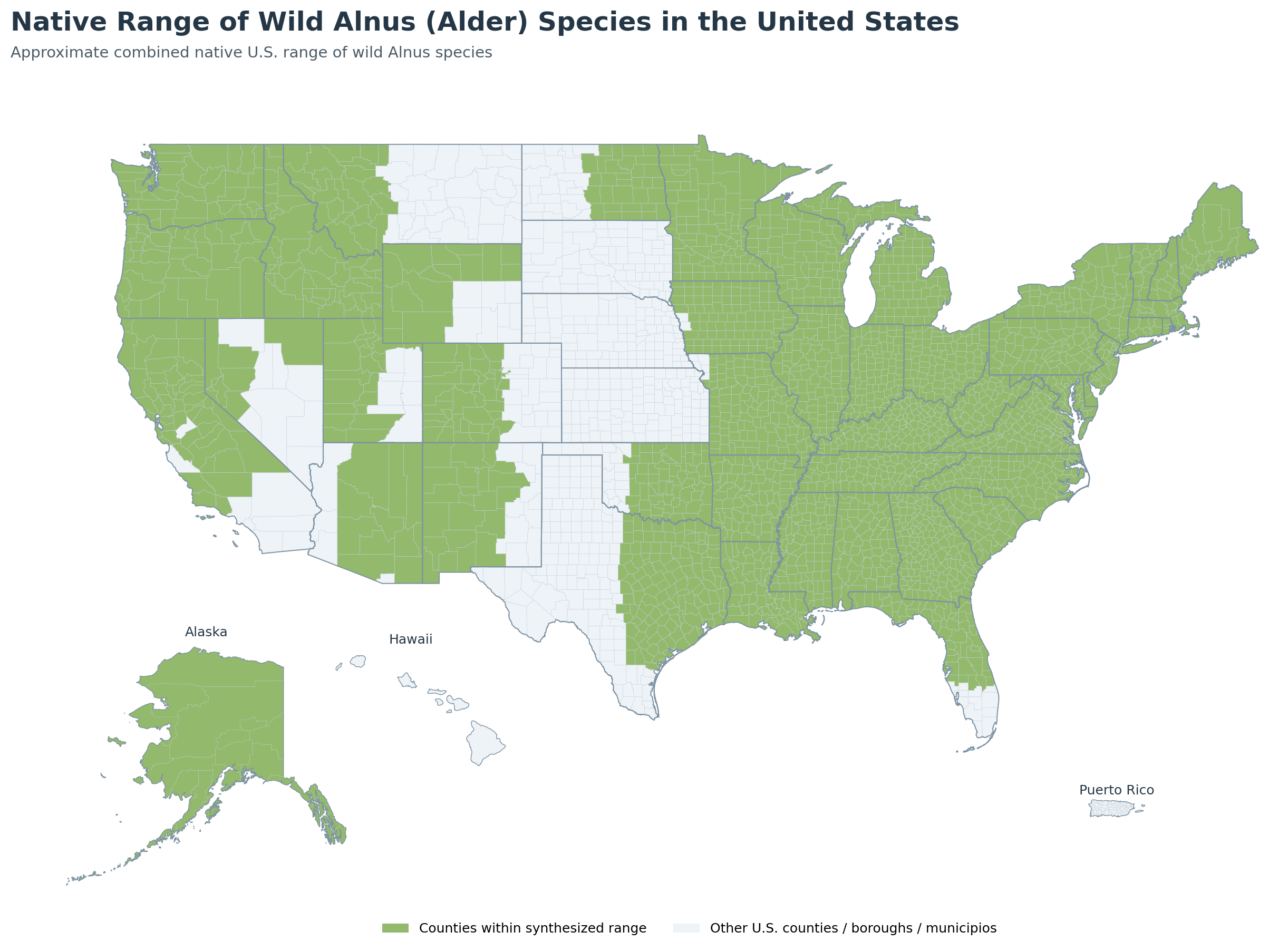
This map is native-range focused, so it does not treat ornamental or cultivated plantings as a basis for shading. That matters less for alder than for some landscaping genera, but it is still an important interpretation choice for readers.1,2
Alder (Alnus) Pollen and the Spring Allergy Season
For most of the United States and Canada, alder belongs to the first major wave of tree pollen each year. In milder western coastal climates, alder pollen can become important very early, sometimes before many people are thinking about spring allergies at all. In colder continental and northern settings, the main alder season shifts later into spring. The broad pattern is still the same: alder is usually an early-season tree allergen, not a summer pollen source.2,3,4
Red alder is especially important in the Pacific Northwest, where aerobiology data show that Alnus can contribute heavily to annual airborne pollen totals. That helps explain why patients in places like western Washington may notice symptoms early and consistently during the tree-pollen period.4
The timing is not identical across the genus. Most native alders flower before or near leaf emergence in late winter or spring, but seaside alder is unusual enough that it deserves separate mention for flowering in late summer and early fall. For most allergy sufferers, though, the clinically relevant alder story is still an early tree-pollen season story.2
Environmental Conditions That Trigger Alder (Alnus) Pollen Release
Like other temperate wind-pollinated trees and shrubs, alders respond to the transition from winter dormancy into warmer weather. Once flower structures have matured, mild temperatures help catkins open and release pollen. Dry and breezy conditions tend to increase airborne pollen exposure, while rain can temporarily knock pollen out of the air and reduce daily counts.2,3
Local habitat also shapes exposure. Many alders are associated with streambanks, wetlands, and moist lowlands, so people may notice worse symptoms near riparian corridors, marshy edges, and disturbed wet ground where alder thickets are concentrated. In red alder country, exposure can extend well beyond stream margins because the species is also common in larger forested landscapes and early-successional coastal habitats.2
Health Relevance for Allergy Sufferers
Alder is part of the wider spring Fagales pollen group that includes birch, hazel, and hornbeam. That matters clinically because these pollens share related allergenic proteins and can show substantial IgE cross-reactivity. The best-known major alder allergen, Aln g 1, is a Bet v 1-like protein, which helps explain why patients with birch-related tree-pollen allergy may also react during alder season.5,6
In practical terms, alder pollen can trigger the familiar symptoms of seasonal allergic rhinitis: sneezing, runny nose, nasal congestion, itchy or watery eyes, throat irritation, and sometimes cough or asthma worsening. Because alder often pollinates early, it may be one of the first outdoor pollen triggers of the year. Patients who think they only have "general spring allergies" may actually be reacting to alder and other early tree pollens before grasses ever peak.3,5,6
References
-
Flora of North America. Alnus genus treatment.
https://floranorthamerica.org/Alnus -
Flora of North America. Species treatments for Alnus rubra, A. incana, A. rhombifolia, A. oblongifolia, A. serrulata, and A. maritima.
https://floranorthamerica.org/Alnus_rubra
https://floranorthamerica.org/Alnus_incana
https://floranorthamerica.org/Alnus_rhombifolia
https://floranorthamerica.org/Alnus_oblongifolia
https://floranorthamerica.org/Alnus_serrulata
https://floranorthamerica.org/Alnus_maritima -
National Institute of Environmental Health Sciences. Pollen and Health.
https://www.niehs.nih.gov/health/topics/agents/allergens/pollen -
Lo F, Bitz CM, Battisti DS, Hess JJ. Pollen calendars and maps of allergenic pollen in North America. Aerobiologia. 2019.
https://pmc.ncbi.nlm.nih.gov/articles/PMC6934246/ -
Hauser M, Asam C, Himly M, et al. Bet v 1-like pollen allergens of multiple Fagales species can sensitize atopic individuals. Clinical & Experimental Allergy. 2011.
https://pubmed.ncbi.nlm.nih.gov/22092996/ -
Melnikova DN, Fesun EI, Potapov AE, et al. Structural and Immunological Features of PR-10 Allergens: Focusing on the Major Alder Pollen Allergen Aln g 1. International Journal of Molecular Sciences. 2024.
https://pmc.ncbi.nlm.nih.gov/articles/PMC11084660/