

Palm Pollen and Allergies: Where It Matters in North America
Palms are not a single uniform pollen problem across North America, but they can still matter to allergy sufferers in the places where they are common. In the United States, the strongest outdoor palm exposure is concentrated in Florida, the Gulf and south Atlantic coastal plain, the lower Rio Grande region, desert oasis habitats in the Southwest, Puerto Rico, Hawaii, and some frost-free subtropical landscapes where outdoor palms are long established.1-7
That makes palm pollen different from broad early-spring tree allergens such as alder or birch. Many palms are insect-pollinated rather than strongly wind-pollinated, so palm pollen is often more local and species-specific. Even so, people living near dense native stands, tropical urban plantings, or desert palm groves can still notice a real seasonal exposure burden.1,8-11
Palm Species and Distribution in North America
Flora of North America treats the palm family, Arecaceae, as a modest but important part of the North American flora, with the wild mainland U.S. range centered far to the south.1 For allergy relevance, a smaller set of palms matters more than the whole family. In the Southeast, saw palmetto (Serenoa repens) is one of the defining palms of sandy coastal and flatwoods habitats; cabbage palmetto (Sabal palmetto) is a major coastal plain palm; dwarf palmetto (Sabal minor) extends well inland across Gulf states into Texas and Oklahoma; Texas palmetto (Sabal mexicana) is tied to the lower Rio Grande region; and needle palm (Rhapidophyllum hystrix) adds a more localized inland southeastern range.2,12
South Florida adds several native palms with narrower but important outdoor footprints, including paurotis palm (Acoelorraphe wrightii), silver palm (Coccothrinax argentata), Florida royal palm (Roystonea regia), and Sargent's cherry palm (Pseudophoenix sargentii subsp. sargentii). In the Southwest, California fan palm (Washingtonia filifera) is the key native palm for allergy geography because it forms natural desert groves in southeastern California, western Arizona, and nearby desert transition areas.2
Puerto Rico and Hawaii deserve separate mention. Puerto Rico has native palms that are clearly part of the outdoor flora, especially Puerto Rico royal palm (Roystonea borinquena) and sierra palm (Prestoea montana). Hawaii's native palm story is centered on loulu (Pritchardia), while many other palms there are cultivated or naturalized rather than native.4-7 That native-versus-established distinction also matters in south Florida, where outdoor exposure can reflect both wild native palms and long-established introduced palms such as coconut palm, Senegal date palm, Chinese fan palm, and areca palm.3
Range of Palm Trees and Shrubs in North America
The map below summarizes the approximate combined U.S. range of native wild palms plus limited tropical-island and south Florida areas where established outdoor palms are part of the real exposure picture.
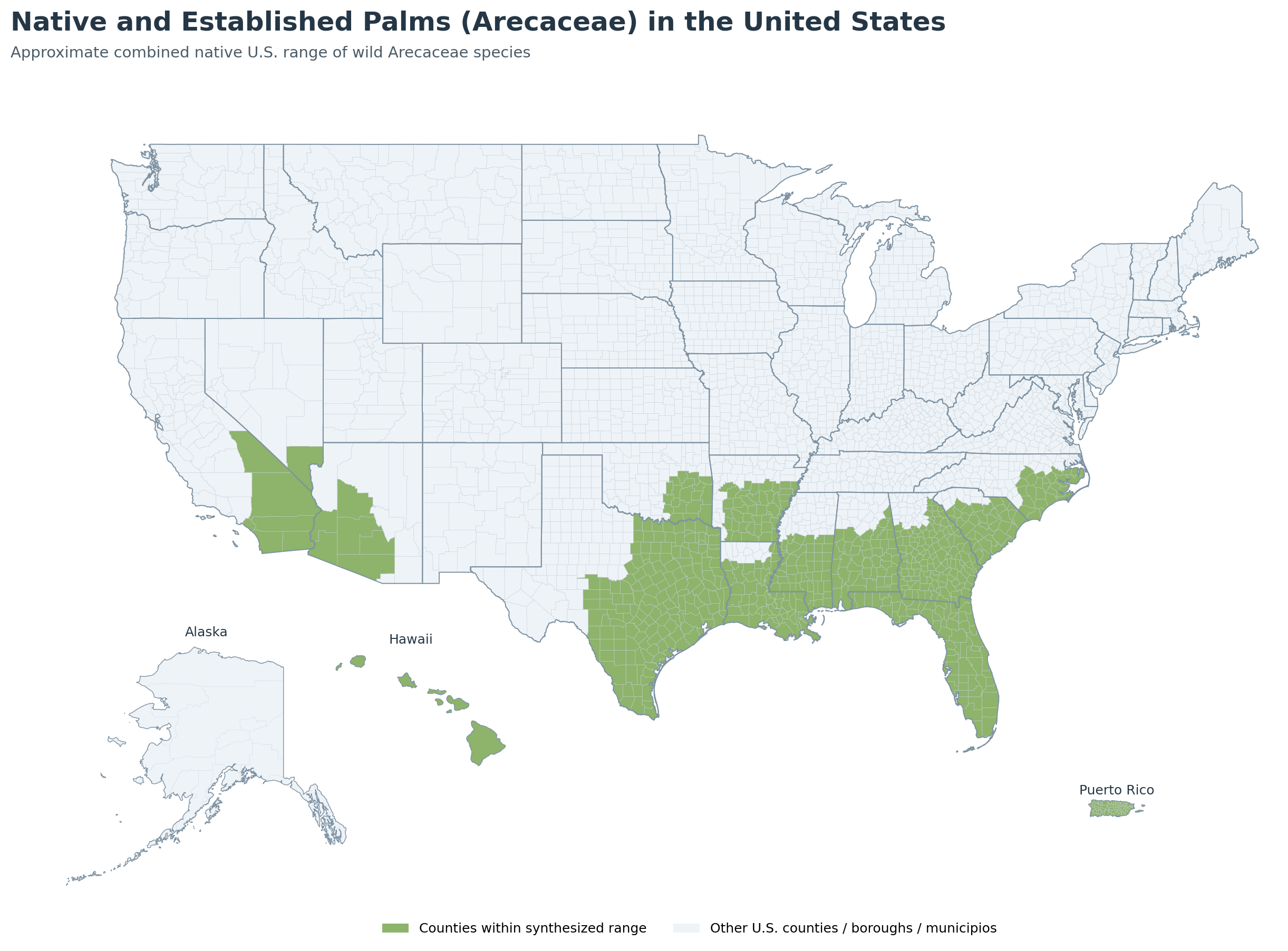
Map notes: This is a county-level cartographic synthesis for public education, not a verified county occurrence atlas for each species.1-7,12 The strongest continuous palm range is in Florida and the broader southeastern coastal plain, with additional inland coverage where Sabal minor and needle palm extend into lowland southeastern habitats. Separate palm regions occur in the lower Rio Grande area and in desert spring and wash systems of southeastern California, western Arizona, and southern Nevada for California fan palm.2,12
Puerto Rico and Hawaii are intentionally treated as jurisdiction-wide palm-presence insets because palms are part of the native or established outdoor flora there, while the inset geographies are too coarse for a species-by-species island synthesis.4-7 Alaska is intentionally excluded because this map is not a map of cultivated greenhouse or ornamental plantings, and the source framework used here does not support a wild or established outdoor palm range there.1-7 The map also does not try to represent every ornamental palm planted in warm U.S. cities outside the shaded area.1-3
Palm Pollen and the Spring to Summer Allergy Season
For much of the mainland United States, the most relevant outdoor palm flowering period falls in spring or spring into summer. That pattern fits several of the palms most likely to affect exposure, including saw palmetto, Sabal species, California fan palm, and paurotis palm.2 In frost-free tropical or subtropical settings, the season can stretch longer and may not behave like a short, sharply defined spring pulse.
Puerto Rico and Hawaii are good examples of that difference. In tropical climates, different palms can flower at different times, and some may flower over extended periods. The Puerto Rico royal palm, for example, is described by the U.S. Forest Service as blooming throughout the year.4 For patients, that means palm pollen is usually more regional than continent-wide: spring is still the main mainland pattern, but low-latitude exposure can be longer and less predictable.2,4
Environmental Conditions That Trigger Palm Pollen Release
Palm pollen release depends on the species, local climate, and whether the palm is growing in a dry desert, a humid coastal plain, or a tropical urban landscape. In general, once flowering structures are mature, warm conditions help pollen release move forward, while dry and breezy weather makes airborne exposure more noticeable. Rain can temporarily lower the amount of pollen in the air.2,8
Where people live also changes the practical exposure picture. Symptoms are more likely near dense stands of saw palmetto and Sabal in the Southeast, around desert fan-palm groves in the Southwest, and in subtropical neighborhoods where many palms flower close to homes, streets, or workplaces. Because many palms are not dominant long-distance wind pollinators, nearby flowering plants can matter more than distant regional vegetation.1,2,8
Health Relevance for Allergy Sufferers
Palm pollen can still trigger the usual pollen-allergy symptoms in sensitized people, including sneezing, nasal congestion, runny nose, itchy or watery eyes, throat irritation, and asthma worsening.8 The main clinical point, though, is that palm allergy is usually local and species-specific rather than a single broad North American pollen season shared evenly across the whole family.
The strongest allergy literature is tied to date palms and related ornamental palms in the genus Phoenix. Published work has identified allergens such as Pho d 2, a profilin with meaningful IgE cross-reactivity to other plant profilins, and case reports have described rhinoconjunctivitis and occupational asthma linked to Phoenix pollen exposure.9-11 That does not mean every palm has the same allergy importance. It does mean palm pollen should be taken seriously in places where palms are abundant outdoors, especially in subtropical and tropical communities where exposure can be prolonged and repeated through the year.3,4,9-11
References
-
Flora of North America. Arecaceae family treatment.
https://floranorthamerica.org/Arecaceae -
Flora of North America. Treatments for Serenoa repens, Sabal, Sabal minor, Sabal palmetto, Sabal mexicana, Washingtonia filifera, Acoelorraphe wrightii, Coccothrinax argentata, Roystonea regia, and Pseudophoenix sargentii subsp. sargentii.
https://floranorthamerica.org/Serenoa_repens
https://floranorthamerica.org/Sabal
https://floranorthamerica.org/Sabal_minor
https://floranorthamerica.org/Sabal_palmetto
https://floranorthamerica.org/Sabal_mexicana
https://floranorthamerica.org/Washingtonia_filifera
https://floranorthamerica.org/Acoelorraphe_wrightii
https://floranorthamerica.org/Coccothrinax_argentata
https://floranorthamerica.org/Roystonea_regia
https://floranorthamerica.org/Pseudophoenix_sargentii_subsp._sargentii -
Flora of North America. Introduced and naturalized Florida palm treatments, including Cocos nucifera, Phoenix reclinata, Livistona chinensis, and Dypsis lutescens.
https://floranorthamerica.org/Cocos_nucifera
https://floranorthamerica.org/Phoenix_reclinata
https://floranorthamerica.org/Livistona_chinensis
https://floranorthamerica.org/Dypsis_lutescens -
U.S. Forest Service, El Yunque National Forest. Puerto Rico Royal Palm (Roystonea borinquena).
https://www.fs.usda.gov/r08/elyunque/animals-plants/plants/puerto-rico-royal-palm -
U.S. Forest Service, International Institute of Tropical Forestry. Prestoea montana (Sierra Palm).
https://research.fs.usda.gov/treesearch/30213 -
U.S. Forest Service. Guide to the Ecological Systems of Puerto Rico.
https://data.fs.usda.gov/research/pubs/iitf/iitf_gtr_35.pdf -
Hawaii Division of Forestry and Wildlife. Loulu; U.S. Fish & Wildlife Service and National Tropical Botanical Garden Hawaiian loulu references.
https://dlnr.hawaii.gov/forestry/plants/loulu/
https://www.fws.gov/species/loulu-pritchardia-napaliensis
https://www.fws.gov/species/loulu-pritchardia-munroi
https://www.fws.gov/species/loulu-pritchardia-lanigera
https://ntbg.org/stories/photo-gallery-into-the-world-of-one-of-hawaiis-rarest-palms/ -
National Institute of Environmental Health Sciences. Pollen.
https://www.niehs.nih.gov/health/topics/agents/allergens/pollen -
Asturias JA, Ibarrola I, Fernández J, et al. Pho d 2, a major allergen from date palm pollen, is a profilin: cloning, sequencing, and immunoglobulin E cross-reactivity with other profilins. Clinical & Experimental Allergy. 2005.
https://pubmed.ncbi.nlm.nih.gov/15784118/ -
Mistrello G, Harfi H, Roncarolo D, et al. Date palm pollen allergoid: characterization of its chemical-physical and immunological properties. International Archives of Allergy and Immunology. 2008.
https://pubmed.ncbi.nlm.nih.gov/17914274/ -
Blanco C, Carrillo T, Quiralte J, et al. Occupational rhinoconjunctivitis and bronchial asthma due to Phoenix canariensis pollen allergy. Allergy. 1995.
https://pubmed.ncbi.nlm.nih.gov/7677245/ -
Clancy KE, Sullivan MJ. Distribution of the needle palm, Rhapidophyllum hystrix. Castanea. 1990.
https://castaneajournal.com/article/distribution-of-the-needle-palm-rhapidophyllum-hystrix/