

News
Birch Pollen and Spring Allergies: Why Paper Birch, River Birch, and Yellow Birch Matter
Birches in the genus Betula are among the most recognizable spring-pollen trees in North America. For allergy sufferers, they matter because birch pollen is lightweight, readily airborne, and strongly associated with classic spring hay fever. In the United States, the biggest wild-birch exposure zones are the Northeast, Great Lakes, Upper Midwest, Alaska, and mountain West, but the birch story does not stop there. River birch extends the genus well into the Mid-Atlantic, Southeast, lower Midwest, and parts of south-central states, so birch-related exposure can appear outside the colder northern forest belt many patients expect.1-3
Birch also matters clinically in a different way from many other tree pollens. The major birch allergen Bet v 1 is one of the best-known pollen proteins in allergy medicine, and sensitization to birch can overlap with reactions to related spring trees and to certain raw plant foods. That makes birch important not only for sneezing and itchy eyes outdoors, but also for the broader pollen-food syndrome pattern some patients notice with foods such as apple, hazelnut, peach, carrot, and celery.5,6
Birch (Betula) Species and Distribution in North America
Flora of North America treats Betula as a diverse North American genus that includes both large trees and smaller boreal or arctic shrubs, but not all birches matter equally for airborne exposure.1 The most important broad-canopy tree birches for patients are usually paper birch (Betula papyrifera), yellow birch (B. alleghaniensis), river birch (B. nigra), and in some regions gray birch (B. populifolia). In Alaska and far northern North America, Alaska or resin birch (B. neoalaskana) and dwarf birches such as B. nana also add to the wild birch footprint, even though low shrub birches are not the same kind of urban pollen presence as large street or forest trees.1
Paper birch is the signature northern birch, native across Alaska, the upper Great Lakes, northern New England, and parts of the Rockies and Pacific Northwest. Yellow birch is centered in the Northeast, Great Lakes, and Appalachian highlands. River birch is the species that changes the map for allergy sufferers: it follows floodplains and stream systems from the Mid-Atlantic and lower Midwest into the Southeast, Gulf states, and parts of Texas and Oklahoma. In the interior West, water birch (B. occidentalis) supplies a separate Rocky Mountain and Intermountain birch pattern tied to canyons, streams, and mountain valleys.1
For patients, that mix matters more than taxonomy alone. Northern forest states often have broad landscape exposure from paper and yellow birch, while farther south the main outdoor birch signal is more often river birch near riparian habitats and planted landscapes. Cultivated Eurasian birches can add local pollen outside the native range, but this article and map focus on the combined native U.S. range of wild birch species.1
Range of Birch (Betula) in North America
The map below summarizes the approximate combined native U.S. range of wild birch species.
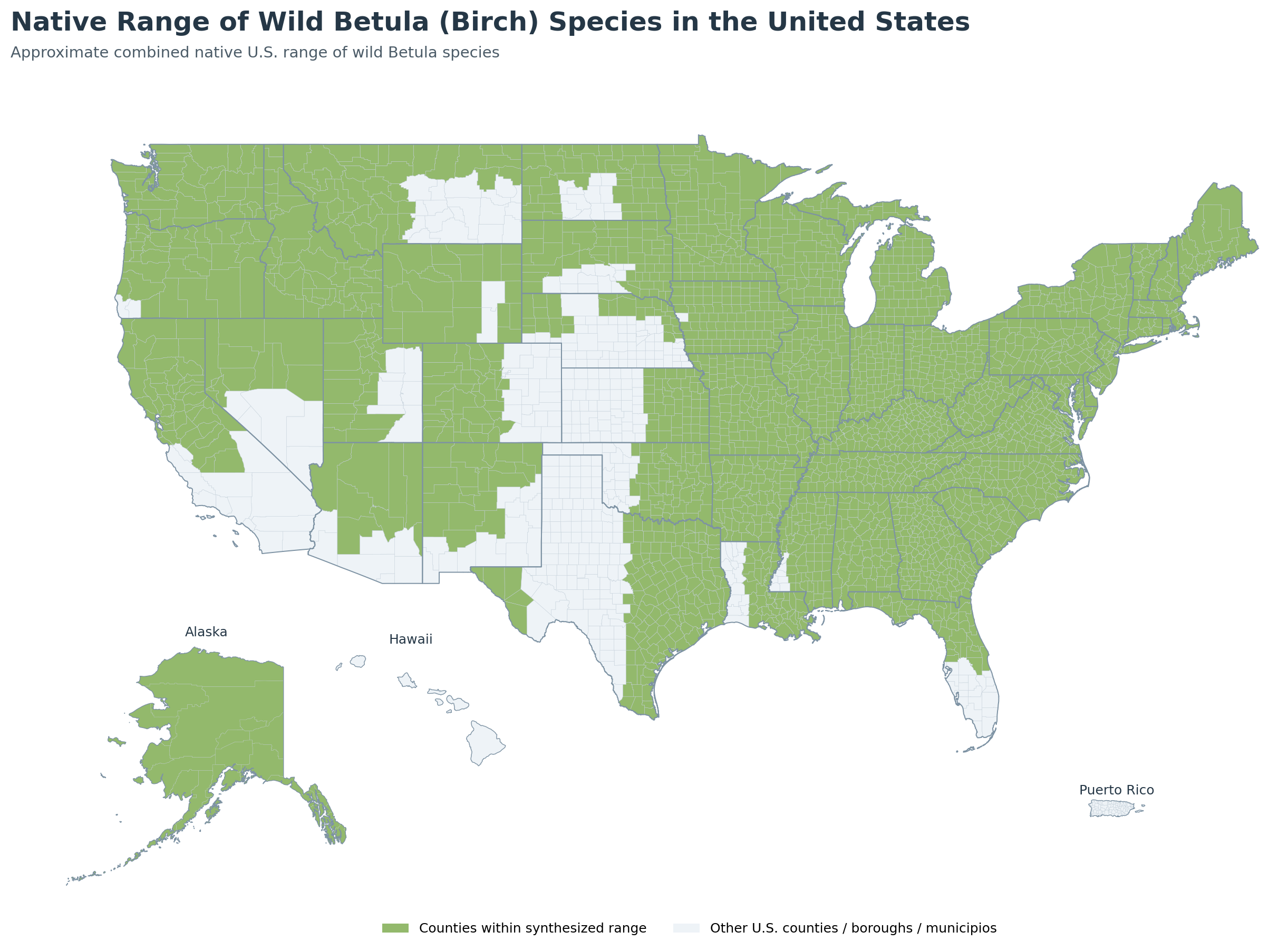
Map notes: This is a county-level cartographic synthesis for public education, not a verified county occurrence atlas for each birch species.1 Counties outside the shaded area can still have ornamental planted birches, especially in cooler urban landscapes.1
Birch (Betula) Pollen and the Spring Allergy Season
Birch is one of the classic spring Fagales pollen groups. North American pollen-calendar work based on National Allergy Bureau stations shows that tree-pollen seasons begin earlier at lower latitudes and later in colder or higher-elevation locations, and birch fits that general pattern. In practical terms, birch pollen often becomes important from March into April in many temperate U.S. settings, then shifts later into late spring in the far North, around the Great Lakes, and in mountain regions.2,3
That timing helps explain why birch symptoms often overlap with alder, hazel, maple, and oak season rather than with the later grass peak. Paper birch and yellow birch help drive the northern forest pattern, while river birch can bring birch exposure into warmer regions where patients may not expect it from the genus name alone.1-3
Environmental Conditions That Trigger Birch (Betula) Pollen Release
Like other temperate trees, birches need winter dormancy followed by spring warming before flowering moves ahead. Modeling studies of U.S. airborne pollen seasons show that birch onset and duration track heat accumulation and geography, with earlier starts in warmer parts of the country and later starts farther north.3 Once catkins are open, warm, dry, and breezy weather usually makes airborne exposure more noticeable, while rain can temporarily lower pollen levels by washing particles out of the air.4
Local habitat still matters. In northern forests, exposure can reflect broad regional tree cover. In southern and central states, exposure may be more concentrated near river corridors, bottomlands, and neighborhoods where river birch is common as both a native tree and a planted ornamental.1,4
Health Relevance for Allergy Sufferers
Birch pollen can trigger the familiar symptoms of seasonal allergic rhinitis, including sneezing, runny nose, nasal congestion, itchy or watery eyes, throat irritation, and asthma worsening in sensitized patients.4 Clinically, birch is especially important because Bet v 1 is a major reference allergen for the whole birch-pollen syndrome. Birch sensitization often overlaps with reactivity to related Fagales pollens such as alder and hazel, which can make the spring tree season feel longer and less species-specific from the patient perspective.5
Birch is also strongly linked to pollen-food allergy syndrome. Because Bet v 1 and related proteins resemble proteins in several raw fruits, nuts, and vegetables, some birch-allergic patients notice itching or tingling of the lips, mouth, or throat after foods such as apple, hazelnut, peach, celery, or carrot. That pattern does not happen in every birch-allergic person, but it is common enough to be a useful clue when spring pollen symptoms and food reactions seem to travel together.6
References
-
Flora of North America. Betula genus treatment and species treatments for Betula papyrifera, B. alleghaniensis, B. nigra, B. populifolia, B. pumila, B. occidentalis, B. cordifolia, B. neoalaskana, and B. nana.
https://dev.floranorthamerica.org/Betula
https://floranorthamerica.org/Betula_papyrifera
https://floranorthamerica.org/Betula_alleghaniensis
https://floranorthamerica.org/Betula_nigra
https://floranorthamerica.org/Betula_populifolia
https://floranorthamerica.org/Betula_pumila
https://floranorthamerica.org/Betula_occidentalis
https://floranorthamerica.org/Betula_cordifolia
https://floranorthamerica.org/Betula_neoalaskana
https://floranorthamerica.org/Betula_nana -
Lo F, Bitz CM, Battisti DS, Hess JJ. Pollen calendars and maps of allergenic pollen in North America. Aerobiologia. 2019.
https://www.atmos.washington.edu/~david/Lo_etal_2019.pdf -
Zhang Y, Bielory L, Cai T, Mi Z, Georgopoulos P. Predicting onset and duration of airborne allergenic pollen season in the United States. Atmospheric Environment. 2015.
https://doi.org/10.1016/j.atmosenv.2014.12.019 -
National Institute of Environmental Health Sciences. Pollen and Health.
https://www.niehs.nih.gov/health/topics/agents/allergens/pollen -
Hauser M, Asam C, Himly M, et al. Bet v 1-like pollen allergens of multiple Fagales species can sensitize atopic individuals. Clinical & Experimental Allergy. 2011.
https://pubmed.ncbi.nlm.nih.gov/22092996/ -
Aarnisalo AS, Hegedus A, Faber MA, et al. The effect of subcutaneous and sublingual birch pollen immunotherapy on birch pollen-related food allergy: a systematic review. Frontiers in Allergy. 2024.
https://pmc.ncbi.nlm.nih.gov/articles/PMC11187334/
Comments