

News
Hornbeam and Hop-Hornbeam Pollen: A Spring Trigger Hiding in Eastern Forests and Southwestern Canyons
Hornbeam (Carpinus) and hop-hornbeam (Ostrya) are not the loudest tree-pollen story in North America, but they still matter to allergy sufferers because they belong to the same birch-family branch of the spring Fagales pollen season that includes alder, birch, and hazel.1-7 In the United States, their combined outdoor range stretches across much of the eastern deciduous forest and then reappears in smaller canyon and mountain pockets of the Southwest.1-4
For patients, that means exposure is often real but local. These are usually smaller forest trees rather than canopy dominants on the scale of oaks or many pines, so symptoms tend to matter most where hornbeam and hop-hornbeam are common in nearby streambottoms, moist hardwood woods, dry upland slopes, and sheltered canyon habitats.1-5
Carpinus and Ostrya Species and Distribution in North America
Flora of North America recognizes one native Carpinus species in the flora, American hornbeam (Carpinus caroliniana), and three native Ostrya species: eastern hop-hornbeam (Ostrya virginiana), Knowlton's hop-hornbeam (O. knowltonii), and the much narrower Chisos hop-hornbeam (O. chisosensis).1 For most allergy sufferers, the main eastern story is the pairing of American hornbeam and eastern hop-hornbeam, which often occur together in hardwood forests from New England and the Great Lakes south through the Appalachians, the Mid-Atlantic, the Southeast, and parts of the central states.1-4
American hornbeam is especially tied to rich, moist sites such as stream banks, flood plains, swamps, hammocks, coves, and lower protected slopes, although it also reaches dry-mesic upland hardwood forests.2 Eastern hop-hornbeam is often a little broader ecologically, occurring on moist to dry forested hillsides, ridges, and well-drained flood plains, which helps explain why the combined eastern range is broad even though these are usually modest-sized trees.3
The western part of the map is much more localized. Knowlton's hop-hornbeam occurs sporadically in Arizona, New Mexico, Utah, and Texas, especially along streamsides and rocky slopes in moist canyons, and Chisos hop-hornbeam is restricted to the Chisos Mountains of Big Bend National Park in Texas.1,4 European hornbeam (Carpinus betulus) is planted in North America, but Flora of North America notes that it has not become naturalized, so ornamental plantings are not the basis for this range summary.1
Range of Carpinus and Ostrya in North America
The map below summarizes the approximate combined native U.S. range of wild hornbeam and hop-hornbeam species.
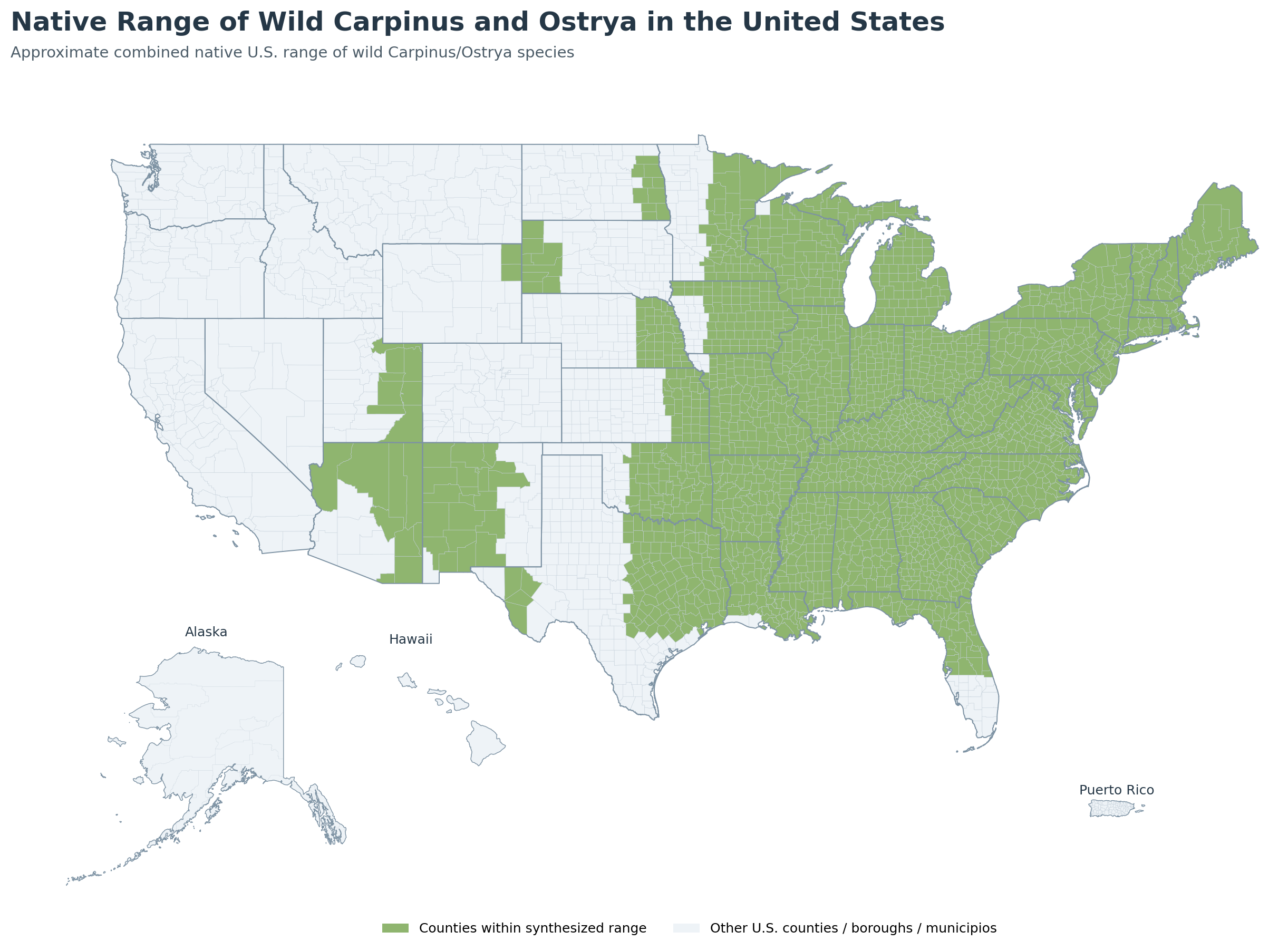
Map notes: This map follows the combined native U.S. range of wild Carpinus and Ostrya species rather than ornamental plantings.
Carpinus and Ostrya Pollen and the Spring Allergy Season
These trees are spring pollen sources. American hornbeam flowers from late March to early May in the Southeast and from April into May farther north, usually before the leaves are fully grown.2 Eastern hop-hornbeam flowers from late March to mid-April in the South and from mid-May to mid-June in the North, while Knowlton's hop-hornbeam flowers from March through May in the Southwest.3,4
That timing places hornbeam and hop-hornbeam in the broader spring tree-pollen window rather than the summer grass season. In practical terms, they can help sustain symptoms after the very earliest tree pollens have started and before grasses become the dominant outdoor trigger.2-7
Environmental Conditions That Trigger Carpinus and Ostrya Pollen Release
Like other wind-pollinated spring trees, hornbeam and hop-hornbeam release pollen once catkins have matured and warming weather pushes flowering forward.1-4 Warm, dry, breezy days usually make airborne pollen more noticeable, while rain can temporarily lower concentrations by washing pollen out of the air.5
Habitat also shapes exposure. American hornbeam is often most relevant near bottomlands, stream corridors, swamps, and protected mesic woods, while eastern hop-hornbeam can add exposure on drier upland slopes and ridges. In the Southwest, exposure is much more tied to specific canyon and mountain habitats than to whole-state coverage.1-4
Health Relevance for Allergy Sufferers
For sensitized patients, hornbeam and hop-hornbeam pollen can contribute to the familiar symptoms of seasonal allergic rhinitis: sneezing, runny nose, nasal congestion, itchy or watery eyes, throat irritation, and asthma flare-ups.5 Their allergy importance is increased by the fact that they sit inside the same Betulaceae and broader Fagales group as birch, alder, and hazel, whose pollen allergens show substantial molecular cross-reactivity.6,7
That cross-reactivity means some people who think of themselves as mainly "birch allergic" or "tree-pollen allergic" may also react during hornbeam or hop-hornbeam season. Hornbeam allergen Car b 1 and hop-hornbeam allergen Ost c 1 are part of the same Bet v 1-like allergen family that helps link these spring tree pollens clinically.6,7 Even though hornbeam and hop-hornbeam are often more local than major canopy pollen sources, they are still worth considering when spring symptoms line up with mixed hardwood forests or southwestern canyon woodlands near home, work, or recreation areas.2-7
References
-
Flora of North America. Carpinus and Ostrya genus treatments, with species treatments for Carpinus caroliniana, Ostrya virginiana, and Ostrya knowltonii.
https://floranorthamerica.org/Carpinus
https://floranorthamerica.org/Carpinus_caroliniana
https://floranorthamerica.org/Ostrya
https://floranorthamerica.org/Ostrya_virginiana
https://floranorthamerica.org/Ostrya_knowltonii -
U.S. Forest Service Fire Effects Information System. Carpinus caroliniana (American hornbeam).
https://research.fs.usda.gov/feis/species-reviews/carcar -
U.S. Forest Service Fire Effects Information System. Ostrya virginiana (eastern hophornbeam).
https://research.fs.usda.gov/feis/species-reviews/ostvir -
U.S. Forest Service Fire Effects Information System. Ostrya knowltonii (Knowlton's hophornbeam).
https://research.fs.usda.gov/feis/species-reviews/ostkno -
National Institute of Environmental Health Sciences. Pollen and Health.
https://www.niehs.nih.gov/health/topics/agents/allergens/pollen -
Hauser M, Asam C, Himly M, et al. Bet v 1-like pollen allergens of multiple Fagales species can sensitize atopic individuals. Clinical & Experimental Allergy. 2011.
https://pubmed.ncbi.nlm.nih.gov/22092996/ -
Asam C, Hofer H, Wolf M, et al. Tree pollen allergens-an update from a molecular perspective. Allergy. 2015.
https://pmc.ncbi.nlm.nih.gov/articles/PMC5102629/
Comments