

News
Maple Pollen and Spring Allergies: Why Boxelder and Other Maples Matter
Maple trees in the genus Acer are among the most widespread deciduous trees in temperate North America. Across the United States, Canada, and Puerto Rico, maples are common in forests, parks, and residential landscapes, making their pollen a regular component of the early-spring airborne allergen environment. The genus contains roughly 110–120 species globally, with about 12–15 native species in North America and several additional ornamental species planted widely in urban landscapes.1
In modern plant taxonomy the genus belongs to the soapberry family (Sapindaceae), although historically it was classified in its own family, Aceraceae.1 Because many maples bloom very early in the year—often before leaves emerge—they contribute to the first major wave of tree pollen exposure each spring.2
Maple Species and Distribution in North America
North American maples occur across most temperate climates from Alaska and Canada to northern Mexico and the Caribbean. In the United States and Canada, the highest diversity occurs in the eastern deciduous forest region, where several species often coexist.1 Western North America supports fewer species but includes several distinctive regional maples. Puerto Rico has only limited representation of the genus, primarily through cultivated ornamental species rather than native populations.
Several maple species are particularly common and relevant for pollen exposure:
- Red maple (Acer rubrum) – one of the most widespread trees in eastern North America
- Silver maple (Acer saccharinum) – common in floodplains and urban plantings across the eastern and central United States
- Sugar maple (Acer saccharum) – dominant in northern hardwood forests of the Northeast and Great Lakes region
- Box elder (Acer negundo) – a fast-growing maple found across much of North America and the species most frequently associated with allergic reactions
- Bigleaf maple (Acer macrophyllum) – native to the Pacific Northwest coastal region
- Mountain maple (Acer spicatum) and striped maple (Acer pensylvanicum) – understory species of northeastern forests
- Rocky Mountain maple (Acer glabrum) and bigtooth maple (Acer grandidentatum) – characteristic species of western mountainous regions3
Box elder deserves particular attention for allergy sufferers because it is primarily wind-pollinated and produces abundant airborne pollen, whereas some other maple species rely partly on insects for pollination.4 This difference can lead to much higher airborne pollen counts where box elder trees are common.
Range of Maple Trees in North America
The map below summarizes the approximate natural distribution of maple species across the United States and Canada. Cultivated maples occur outside these areas as well, especially in urban landscaping.
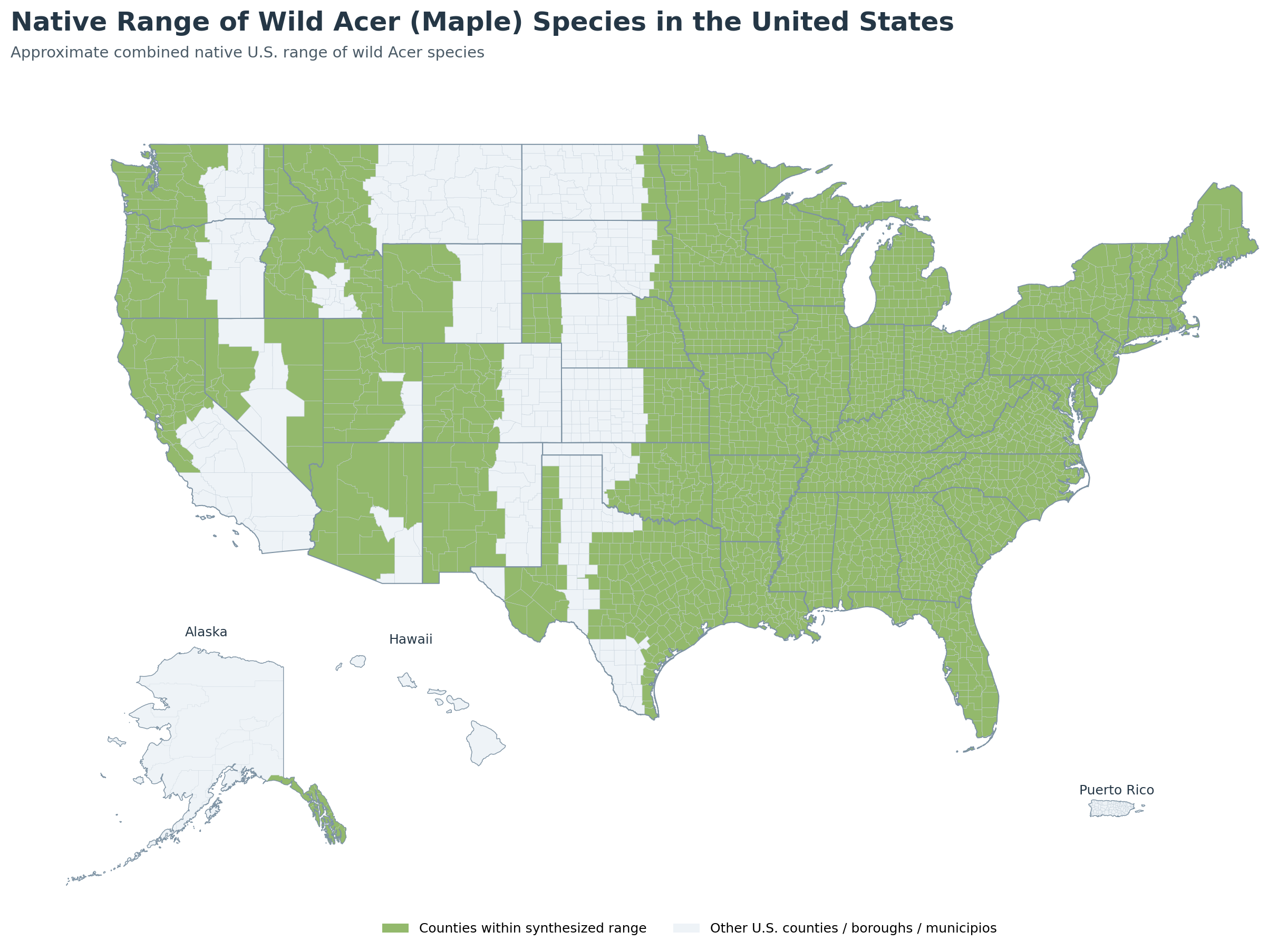
These generalized patterns reflect compiled distribution data from the U.S. Forest Service and North American forest ecology research.1
Maple Pollen and the Spring Allergy Season
Maples are among the earliest flowering trees in North America, often beginning pollen release in late winter or very early spring depending on latitude. In southern regions of the United States, maple pollen may appear as early as January or February, while in northern states and Canada the main pollen season typically occurs March through April.2 By late spring most maple species have finished pollinating.
Many maple species flower before their leaves emerge, which increases pollen dispersal because there is no foliage to obstruct air movement.5 Flowers are usually small clusters of yellow, green, or red blossoms located along twigs. These flowers produce microscopic pollen grains that are easily transported by wind.
Under the microscope, maple pollen grains typically measure about 20–50 micrometers in diameter and have a somewhat spherical shape with three elongated furrows (called colpi).6 Their outer wall, known as the exine, often shows a wrinkled or finely textured pattern. These grains are small enough to remain airborne and travel significant distances from the source tree, meaning pollen detected in monitoring stations may originate from trees miles away.7
Environmental Conditions That Trigger Maple Pollen Release
The timing of maple flowering is closely tied to seasonal temperature patterns. Like most temperate trees, maples require a period of winter chilling to break dormancy. Once this chilling requirement has been satisfied, warming temperatures in late winter begin to trigger bud development.5
Researchers typically describe flowering onset using growing degree day (GDD) accumulation, a measure of heat buildup above a baseline temperature—often around 10 °C (50 °F) for many temperate trees.5 When enough heat units accumulate, buds open and flowering begins. While exact thresholds vary by species and location, maple pollen release generally begins when daytime temperatures consistently exceed about 10–13 °C (50–55 °F) following winter dormancy.
Weather conditions also strongly influence daily pollen concentrations. Warm, dry, and breezy conditions tend to produce the highest airborne pollen levels, while rainfall can temporarily suppress pollen by washing it out of the air.7 Late frosts may reduce flowering in some years, lowering pollen production.
Health Relevance for Allergy Sufferers
For people sensitive to tree pollens, maple pollen can trigger the classic symptoms of allergic rhinitis (hay fever). These reactions occur when the immune system recognizes certain pollen proteins as allergens and produces immunoglobulin E (IgE) antibodies against them.4 Upon exposure, mast cells release histamine and other inflammatory chemicals that cause symptoms such as:
- sneezing
- nasal congestion
- runny nose
- itchy or watery eyes
- throat irritation
- coughing or asthma flare-ups
Because maples bloom early in the year, symptoms caused by maple pollen often appear before grass pollen becomes common.2 In regions with many maple species flowering sequentially, the maple pollen period can last several weeks.
Among North American maples, box elder (Acer negundo) pollen has been studied most extensively in allergy research because of its strong association with sensitization in pollen-allergic patients.4 However, cross-reactivity between related tree pollens means that individuals allergic to one maple species may react to pollen from others.
References
-
U.S. Forest Service. Silvics of North America: Acer spp.
https://www.fpl.fs.usda.gov/documnts/TechSheets/HardwoodNA/htmlDocs/acersp1.html -
United States Environmental Protection Agency. Climate Change and Pollen Seasons.
https://www.epa.gov/climate-indicators/climate-change-indicators-pollen-season -
Cornell University / USDA. North American Maple Syrup Producers Manual.
https://mapleresearch.org/pub/manual/ -
Thermo Fisher Scientific. Allergen Encyclopedia – Acer negundo.
https://www.thermofisher.com/phadia/wo/en/resources/allergen-encyclopedia/t1.html -
Richardson, A. et al. Phenology of temperate forest trees and temperature triggers for budburst and flowering. Agricultural and Forest Meteorology.
-
Pollen.com Aerobiology Research Database – Acer pollen morphology.
https://www.pollen.com/research/genus/acer -
National Institute of Environmental Health Sciences. Pollen and Health.
https://www.niehs.nih.gov/health/topics/agents/allergens/pollen
Comments