

News
Grass Pollen Stays High Across the South as Tree Pollen Remains Active From the Midwest to Puerto Rico
Grass pollen season started in earnest last week across a broad swath of the U.S., especially in the South and West, while the Midwest and Northeast still suffer from high tree pollen levels.
National Overview
Grass pollen is the clearest burden for allergy sufferers, especially across the South. South Central stations remained broadly elevated, with Houston, Oklahoma City, Tulsa, and Waco all reaching high grass levels. In the Southeast, Cincinnati stood out after moving into Very High, while Greenville and Washington also stayed elevated.
Tree pollen remained a meaningful problem, but it was more scattered than the grass pattern. The Midwest still had several elevated tree stations, led by Chicago, Greenfield, Madison, and Omaha. Puerto Rico slipped below last week's peak but remained active, with both Caguas and San Juan still in high tree territory.
The Northeast stayed mostly below high grass levels, but trees were still an issue around Armonk and Union. In the West, the highest readings were more localized: Eugene reached high grass, while Fairbanks, Reno, and Seattle carried high tree readings.
Weeds were quiet across the reporting stations, with no high weed readings. Mold was also mostly low or moderate; Tulsa was the main exception after reaching a high mold level.
High Allergy Burden Locations
| Location | Allergen | Level | Drivers |
|---|---|---|---|
| Cincinnati (Florence), KY | Grass | Very High | Grass Family, all types |
| Armonk, NY | Tree | High | Oak |
| Caguas (Centro), PR | Tree | High | All identified tree pollen not counted elsewhere |
| Charleston (Summerville), SC | Tree | High | Pine Family with air bladders |
| Chicago (Melrose Park), IL | Grass | High | Grass Family, all types |
| Chicago (Melrose Park), IL | Tree | High | Pine Family with air bladders |
| Eugene, OR | Grass | High | Grass Family, all types |
| Fairbanks, AK | Tree | High | Birch; Poplar, Cottonwood, Aspen |
| Greenfield, WI | Tree | High | Oak; Mulberry; Willow |
| Greenville, SC | Grass | High | All identified grass pollen not counted elsewhere |
| Greenville, SC | Tree | High | Pine Family with air bladders |
| Houston (Medical Center), TX | Grass | High | All identified grass pollen not counted elsewhere |
| Madison, WI | Tree | High | Oak; Mulberry; Birch |
| Oklahoma City, OK | Grass | High | Grass Family, all types |
| Omaha (Bellevue), NE | Grass | High | Grass Family, all types |
| Omaha (Bellevue), NE | Tree | High | Mulberry; Walnut, Butternut |
| Reno (Sparks), NV | Tree | High | Pine Family with air bladders |
| San Juan, PR | Grass | High | Grass Family, all types |
| San Juan, PR | Tree | High | All identified tree pollen not counted elsewhere |
| Seattle, WA | Tree | High | Pine Family with air bladders |
| Tulsa (South), OK | Grass | High | Grass Family, all types |
| Tulsa (South), OK | Mold | High | Ascomycete/Ascospore |
| Union, NJ | Tree | High | Pine Family with air bladders |
| Waco (Woodway North), TX | Grass | High | Grass Family, all types |
| Washington (Silver Spring), MD | Grass | High | Grass Family, all types |
| Washington (Silver Spring), MD | Tree | High | Pine Family with air bladders |
Pollen Drivers
Tree pollen had several regional drivers. In the Midwest, oak, mulberry, birch, pine-family pollen, walnut or butternut, and willow all appeared among elevated readings, with mulberry showing up in Greenfield, Madison, and Omaha. In the Southeast, pine-family pollen was the recurring tree driver in Charleston, Greenville, and Washington.
Farther north and west, the tree mix was more localized. Oak drove Armonk's high tree reading, while Union's came from pine-family pollen. Fairbanks had birch and poplar/cottonwood/aspen, and Reno and Seattle were led by pine-family pollen. Puerto Rico's elevated tree readings were tied to the broad general tree category rather than a named species.
Weather Context
Warmer weather coincided with the continued grass burden in the South Central region. Regional highs averaged in the low 80s, up from the mid-70s last week, while Houston, Oklahoma City, Tulsa, and Waco all remained elevated for grass.
The Southeast also turned warmer and much less wet overall, which lined up with Cincinnati's jump to the top grass band and continued high grass or tree readings in Greenville and Washington. The Midwest warmed as well and had less total rain than before, while elevated tree readings persisted in Chicago, Greenfield, Madison, and Omaha.
The West warmed sharply in several inland areas, and that coincided with Eugene's grass increase and Reno's move into high tree levels. Puerto Rico stayed warm and picked up more rain than before, but tree pollen remained high in both Caguas and San Juan.
Map Snapshot
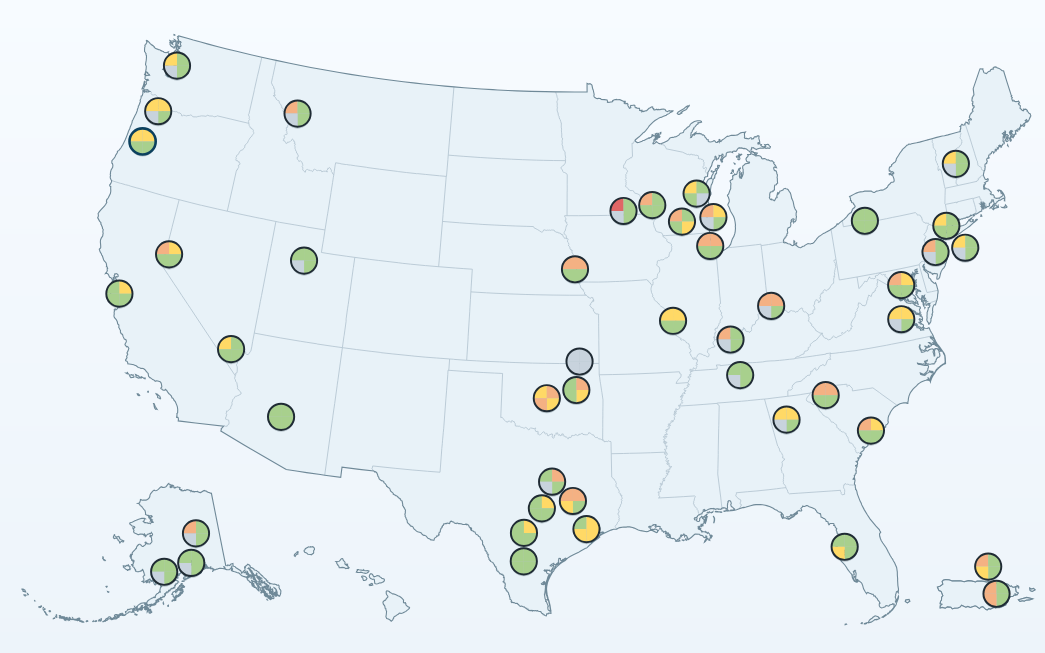
Explore this map by week on the homepage.
Comments